

In recent years most major advertising platforms have introduced AI tools that help you auto-generate an advert. With very little input, it is now extremely easy to generate an advertising campaign. Platforms like Google Ads and Facebook Ads just ask you to enter your target web page, and bingo, they will auto-populate and advert for you! Easy.
But should you rely on an automatically generated advert? Absolutely not!
People who have used these platforms for over 5 or 10 years will start to notice the drawbacks. They will start to see their conversion rates reducing dramatically, and the costs rising. And when you take a closer look at what the platform has generated, you begin to see why it’s often better to completely ignore the automated help.
Google Ads Campaigns
When creating a Google Ads campaign, Google will guide you through the process and automatically generate your entire advert for you, taking content from your website to generate headlines and descriptions. So anyone with zero experience can create a Google Ads campaign with just a few clicks. See below, Google gives you guides on how to achieve an “excellent” campaign.
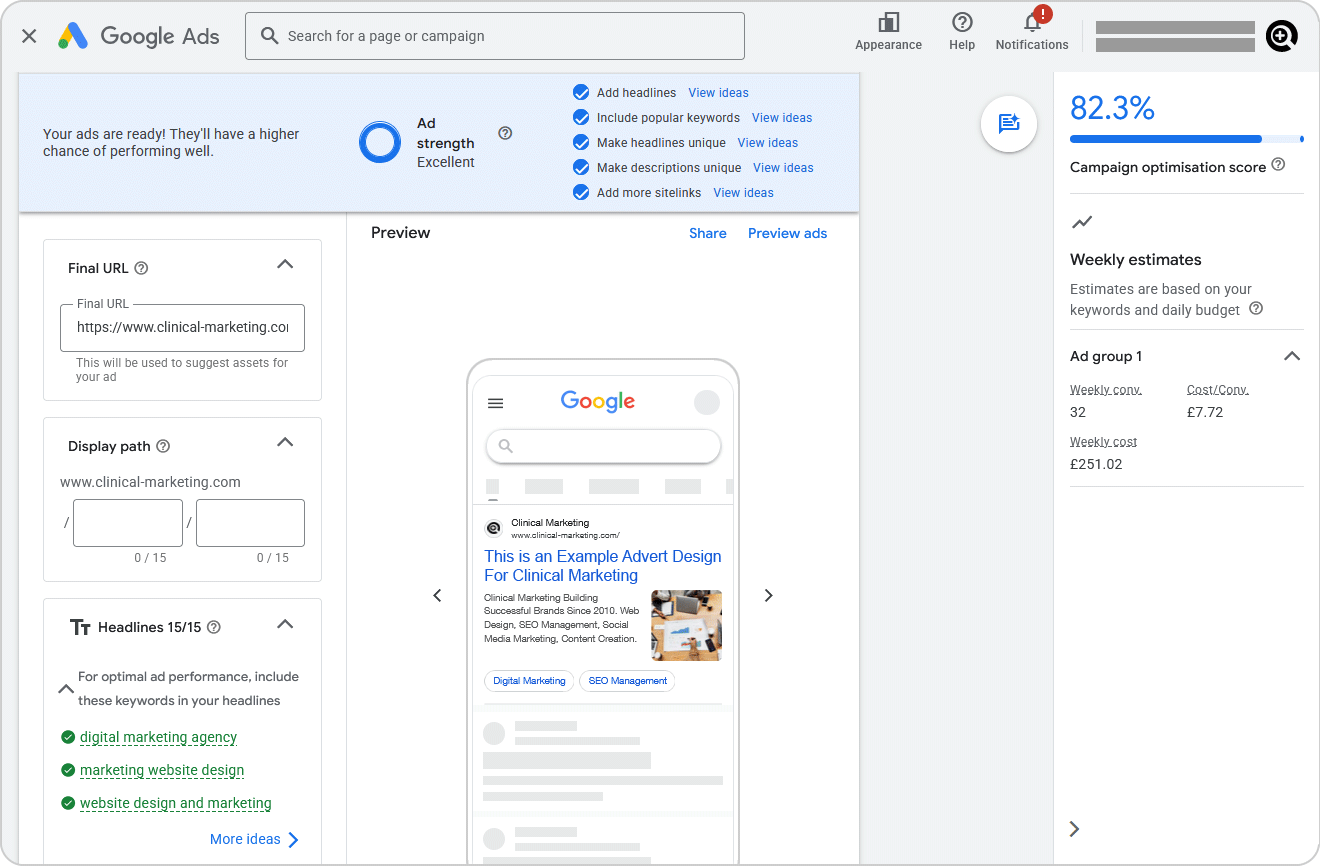
But if you settle for the automated content served up by Google, if you really look at what it’s generated, it’s extremely vague. It just takes random phrases from your website to generate headlines, some of which are completely pointless. You really have to go through the campaign thoroughly and create your own headlines.
Optimisation Score
You would be forgiven for thinking that getting a good optimisation score means that your campaign is set up extremely well. But no. The optimisation score tells you that you are doing what Google wants you to do, hence spending as much money as possible. You learn to ignore the optimisation score as you go along, when you realise that you get better conversion rates with a lower optimisation score.
Keyword Selection
Google will also generate a list of keywords for you, which are vitally important in the targeting of your campaign. But Google will generate around 30 to 40 keywords or phrases that are highly questionable. Always remember that Google wants you to spend as much money as possible! And the more random keywords you have, the more wasted clicks you get.
You really need to refine the list of keywords to target only the most relevant keywords. And also remember, the fewer keywords you use, the lower overall budget you need to run the campaign. For every random keyword you add, you are stretching your budget to target these keywords. So selecting a small list of refined keywords is essential to run a campaign on a tight budget.
Google Ads Tips
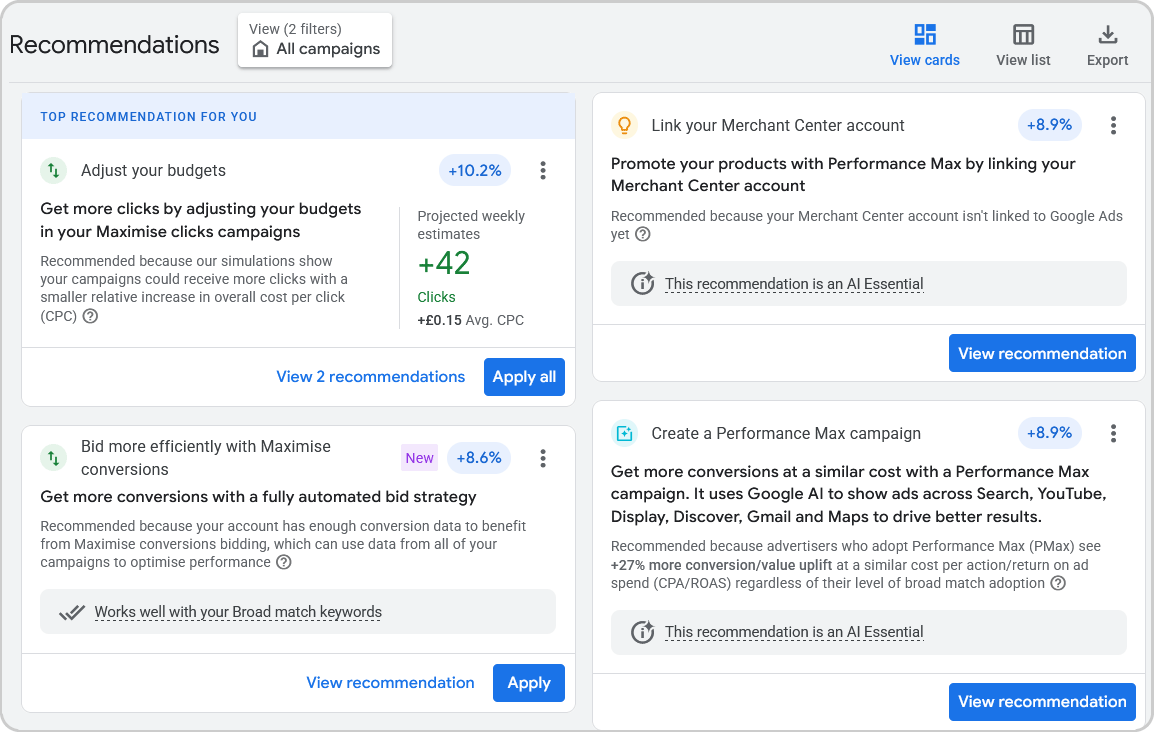
Another fairly new addition to Google Ads is their “recommendations” page. This will give you a number of tips on how to improve your campaigns. But remember, Google is simply trying to force you to increase your budget. And you really need to ignore some of the recommendations.
If you try to get a perfect “optimisation” score, you are just following the advice from Google and almost certainly spending way more money than necessary. The optimisation score is a bit of a sneaky trick by Google, and this is how you can tell if someone is not very experienced – if they follow this dubious advice simply to get a good score.
It can become a vicious circle if you “apply all recommendations” as once you do this, Google will tell you that you now have an excellent optimisation score! But 4 to 6 days later, Google will then tell you that you need to raise your budget, due to the idiotic recommendations that were applied.
Performance Max Campaigns
These campaigns were introduced a few years ago and were designed to make things easy for anyone to advertise, sharing your advert across multiple platforms and avenues. They initially worked quite well, up until the EU privacy laws came in. After this, Performance Max campaigns started to become incredibly unreliable. Because Google lost the ability to target people properly, not being allowed to use specific personal details to target people, these campaigns suddenly became completely random and basically useless.
For a small local campaign, targeting products or services that are widely known about, Performance Max campaigns are occasionally effective. But for national targeting they are completely random, like the machine gun approach, shoot anywhere in a dark room and see what happens!
Historical Marketing Knowledge
Go back 5 to 10 years and these AI tools or recommendations did not exist. You only had the basic statistics to look at, in order to determine if your campaign was effective. And these techniques are still very important. Of course you need to know if the campaign is running effectively, but there are a number of ways to measure this.
Measuring Results
The best way to get highly detailed measurements of your campaign is to instal the Google Tag on your website. But this is not always necessary. In lots of cases I choose NOT to use the Google Tag, as this means you are adding tracking cookies to your website. And then, in an ideal world, you should then use a Cookie Consent banner on your website.
Different Measuring Techniques
But if you don’t want to add tracking cookies to your website, there are other ways to measure the success of your campaign. Such as, simply recording the landing page URL when someone makes an enquiry, as this will tell you if it originated from a Google Ads campaign. This is also true for other platforms like Facebook or LinkedIn.
Or simply don’t measure your results!
If you are confident in your advertising campaign, just let it run without recording the results, which means you can have a completely clean website without any nasty tracking cookies! Of course you will know if you are getting regular sales or customer enquiries, and from the basic statistics in your Google Ads account, you can see exactly how many clicks you are getting, and exactly what people are typing into Google when they clicked on your advert. If the “search terms” are exactly relevant to your products or services, this tells you that your campaign is working well.
Web Design Factors
An advertising campaign can only direct people to your website. Once they are on your website, it depends entirely on the structure and design of your website if that visitor turns into an actual customer. But this is a completely different conversation!
Cold Calls from the Google Ads “Experts”
While I’m on this subject, anyone who sets up a Google Ads campaign will start getting emails and phone calls from the “Google Ads Experts” or “Google Ads Strategists” or “Ads Growth Experts” and please, ignore these people like the plague! What these people do is try to make you spend as much money as possible. Very much like the Google Recommendations, their only job is to make you increase your budget and widen the net.
What they will describe as “potential customers” is what I call “wasted clicks”. If you start widening the net to target any random people, you are simply spending more money. You are paying good money when people click on your advert, but if it’s not precisely what they were searching for, you are just lining Google’s pockets!
A simple example
The “Google Ads Strategists” persuade you to widen the net by suggesting more keywords, or they tell you to “apply all recommendations”. Imagine you were advertising “bicycles”. The “Google Ads Strategists” will suggest that you start using “cars” as a keyword, as there are more people searching for “cars”. They tell you that you will get more clicks from “potential customers” but what you are really doing is wasting your budget on unnecessary clicks. They will show you how your click rate has improved dramatically, but the real goal is to improve the conversion rate, which they don’t tell you about!
I’ve seen multiple cases of this in action, when managing other client’s accounts. I warn my clients to never listen to these idiots, but they are extremely persistent. On a number of occasions I have been made aware of issues on a customer Ads account, their budget has sky rocketed but they are getting fewer customer enquiries. I ask them, have you allowed these “Google Ads Strategists” to make any changes to your campaign? And they always say “Oh yes, they advised me to apply all recommendations”. So I then have to go through their campaign reversing the changes that were made by the idiots. Then normal service resumes and the budget is reduced significantly.
Conclusion
Using AI tools, anyone with zero experience can generate a campaign. But long term experience in running these advertising campaigns will reduce your budget dramatically. Don’t just listen to the advice given to you by the advertising platform, this is like having Count Dracula in charge of a blood bank, and listening to his advice!
Perhaps 90% of marketing companies will settle for the automated advert generated by Google, and blindly apply all recommendations to achieve a good optimisation score, blissfully unaware that they are actually pissing your money against the wall.